Journal of Urban Informatics

Application Domains

  • Aging People in Cities
  • Education Services & Education of Urban Informatics
  • Urban Climate
  • Urban Crime and Security
  • Urban Cyberspace & Physical Space
  • Urban Disaster and Resilience
  • Urban Economics
  • Urban Energy System, Ecology and Hydrology
  • Urban Housing & Real Estate
  • Urban Planning and Design
  • Urban Pollution
  • Urban Public Health and Human Well-being
  • Urban Transportation and Mobility

Relevant Technologies and Issues

  • Artificial Intelligence
  • Data and Algorithmic Bias
  • Impact of Urban Informatics on Cities
  • Multi-source Data Fusion
  • Optimization and Operations Research for Urban Solutions
  • Privacy & Ethics
  • Urban Computing and Urban Big Data Analytics
  • Urban Cyberinfrastructure
  • Urban Geovisualization
  • Urban Internet of Things
  • Urban Models and Simulations
  • Urban Open Data
  • Urban Positioning and Navigation
  • Urban Remote Sensing

Book of Urban Informatics

This is the first book systematically introducing the principles of urban informatics, including urban system theories, techniques and tools for urban big data acquisition, infrastructure and analytics, as well as focusing these new tools on urban problems and possible solutions. The book brings together 40 leading research teams across a wide range of scientific disciplines to deliver collaborative understanding, technology and solutions in the field of urban informatics. The book integrates very diverse tools and techniques associated with analysis of the smart city, but often dealt with separately, under the rubric of geographic information science.
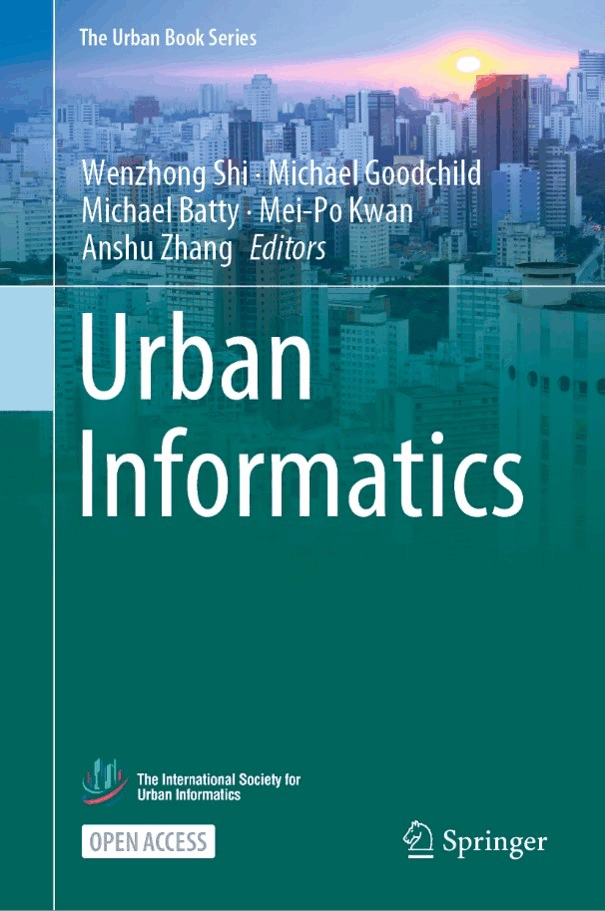
Book Type: eBook with Open Access ISBN 978-981-15-8983-6

Topics

  • Urban Big Data Infrastructure
  • Urban Computing
  • Urban Science
  • Urban Sensing
  • Urban Systems and Applications

Editors

  • Wenzhong Shi, Chair Professor, The Hong Kong Polytechnic University; Academician of the International Eurasian Academy of Sciences; Recipient of Wang Zhizhuo Award, ISPRS
  • Michael F. Goodchild, Professor Emeritus, University of California, Santa BreadcrumbSeparator; Member of the US National Academy of Sciences and American Academy of Arts and Science; Recipient of the Prix Vautrin Lud
  • Michael Batty, Bartlett Professor, University College London;
  • Fellow of the British Academy and the Royal Society (UK); Recipient of the Prix Vautrin Lud
  • Mei-Po Kwan ,Choh-Ming Li Professor, Chinese University of Hong Kong; Fellow of the UK Academy of Social Sciences and the American Association for the Advancement of Science
  • Anshu Zhang, Research Assistant Professor, The Hong Kong Polytechnic University

ISUI Smart City Index 2025


Previous versions

  • ISUI Smart City Index 2023 PDF

Background & Aim

  • The ISUI Smart City Index is jointly developed by ISUI and Otto Poon Charitable Foundation Smart Cities Research Institute (SCRI), endorsed and published by the International Society for Urban Informatics.
  • Echoing the new trend in smart-city development, we aim to develop a universally applicable, objective, comprehensive, and human-centric Smart City Index fully based on publicly available datasets.
  • We hope this index will help cities review their development status and explore ways to become smarter cities for everyone.

Features of This Index

  • Human-centric: concentrated on the impact and changes that smart cities bring to the lives of citizens.
  • Theoretical continuity and conceptual expansion: rooted in the foundational understanding of what constitutes a functioning city.
  • Universality: balanced consideration in stages of development and cultures of the cities.
  • Objectiveness and repeatability: fully based on publicly available data.

Updates in ISUI Smart City Index 2025

  • Expanded conceptual foundation: Integrates core urban factors to bridge historical functions with modern smart city frameworks.
  • Wider coverage: Increased from 50 to 73 cities for better global representation and regional comparison.
  • New evaluation indicators: New evaluation methods for social exclusion and green open public spaces across diverse urban contexts.
  • Improved weighting: Reduced sensitivity to heavy-tailed data distributions in geographic metrics.
  • Bias-adjusted scaling: Refined per capita indicators with nonlinear population adjustments to mitigate large-city undervaluation.

OUR CONTACT

Address: 6/F, Block Z, 11 Yuk Choi Rd, Hung Hom, Kowloon, Hong Kong
Email: info@isocui.org

ISUI SOCIAL MEDIA

Home Page

Twitter

WeChat

LinkedIn

URBAN INFORMATICS

Home Page

Twitter

WeChat

LinkedIn